
Madness
The Blueprints of Delirium
April 25, 2026
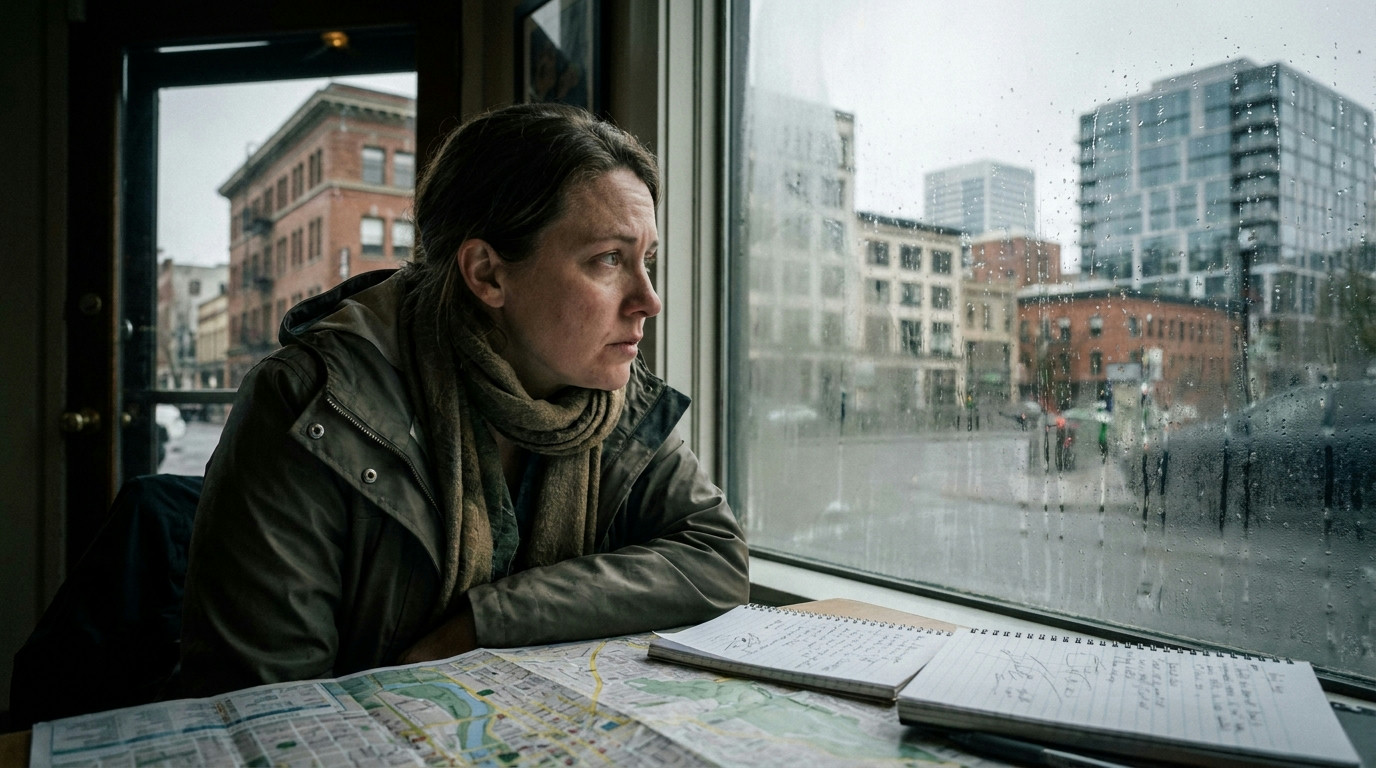
An urban planner in Portland, Oregon, believes she dreamed the city’s skyline into existence, one building at a time. Now she’s terrified of what she might dream next.
The rain in Portland that week was a fine, persistent mist that didn’t so much fall as it did hang in the air, clinging to everything. Clara B., 38, stood across from the Kinsley Tower, a shard of steel and sea-green glass that had only topped out last spring. She ignored the drip of water from her hood onto the bridge of her nose. She was pointing toward the forty-second floor.
“See the mullion pattern?” she asked, her voice quiet, almost reverent. “The third and fourth windows from the left. There’s an extra horizontal bar. It’s a mistake. It breaks the grid.”
I looked. It took a minute, but she was right. A single, superfluous line of black steel, nearly invisible from the ground, disrupted the building’s clean vertical rhythm. An architect’s footnote, a fabricator’s error. A thing you would never notice unless you were looking for it.
“It was like that in the dream, too,” Clara said, looking past me, her gaze fixed on the flaw. “I was seventeen. I drew it in a sketchbook the next morning.”
Clara is an urban designer. Her job is to think about how people move through cities, how parks breathe, how sightlines and setbacks create a feeling of community or alienation. She speaks in a language of schematics and zoning codes. For most of her life, this has been a source of professional comfort. For the last two years, it has become the architecture of a very private and specific dread.
It began with small things. A particular cast-iron bench in Laurelhurst Park, its armrests shaped like sleeping foxes. She’d had a vivid dream of it a decade before it was installed. Then a set of streetlights in the Pearl District with swirling, nautilus-shell heads. She’d doodled them in the margins of her college lecture notes in 2005; the lights went up in 2018.
She chalked it up to coincidence, to the zeitgeist. A designer in another city had simply had the same idea she’d once had. The world is full of echoes.
But the echoes grew louder. They started taking up entire city blocks.
She invited me to her apartment, a spare, orderly space in a converted warehouse. On her dining table, she laid out three Moleskine notebooks, their pages brittle and yellowed with age. They were dream journals, kept meticulously from ages fifteen to twenty-one.
The pages were filled with a teenager’s handwriting and surprisingly technical sketches: building facades, bridge supports, plaza layouts. She would flip a page, then pull up a photo on her laptop. Here was a sketch of a pedestrian bridge, a sweeping white arch, dated 1999. And here was the Tilikum Crossing, opened in 2015.
Here was a drawing of a bronze statue of a flock of birds taking flight from a puddle, dated 2002. And here was the installation on the corner of SW 10th and Yamhill, commissioned in 2019.
And then, the Kinsley Tower. A detailed sketch from August 2001. And there, circled in red ink, a note: *Grid is wrong on the upper floors. One piece is off.*
“I used to think it was a gift. Like being the ghost writer for the city’s subconscious,” she said, closing the oldest notebook. The sound was soft, final. “Now… I don’t sleep very well.”
The city archives and planning department records tell a different story. They tell of committees and review boards, of named architects and engineering firms, of budget proposals and construction timelines stretching back years. Every structure Clara claims as her own has a mundane and verifiable paper trail. The Kinsley Tower’s superfluous mullion is noted in a 2021 contractor’s snag list, the result of a simple measurement error.
There is no evidence of anything other than a city being built in the ordinary way a city is built. Which leaves Clara. Is she retrofitting her memories? Projecting old, forgotten doodles onto a new reality? It is a far more plausible explanation. A mind, under pressure, can build its own ghost architecture.
---
Clara tried to test it. Six months ago, in a fit of what she describes as “desperate, scientific curiosity,” she tried to dream something into existence on purpose. She spent a week focusing, before sleep, on a single, absurd image: a fire hydrant on the corner of her block, painted not red, but a bright, canary yellow with purple polka dots.
She dreamed it. A vivid, hyper-realistic dream. She woke up and wrote it down.
For weeks, nothing happened. The hydrant remained red. The world remained solid. She felt a profound, gut-wrenching relief that tasted, she said, like sanity. She was just a woman who remembered things wrong. She could live with that.
Then, last Tuesday, the city water bureau came. They were replacing the old hydrants on her street with a newer model. The new one that now stands on her corner is not red. It is a standard, factory-issue safety yellow.
No polka dots.
But still.
We were walking back from the tower when she stopped. We were in front of a vast, empty lot, a rectangle of churned mud and gravel behind a chain-link fence. A sign announced the future site of the Odeon Residences. It was nothing but a hole in the ground.
“I had a dream about this one last week,” she said, her voice a whisper. Her eyes traced the shape of the hole, but she was seeing something else, a building that wasn’t there.
“It’s beautiful. All brick and dark wood, with these deep, cantilevered balconies. But there’s a problem with it.” She hugged her arms to her chest, a sudden chill in the damp air. “In the dream, I was in the sub-basement. There’s a hairline crack in the western retaining wall. A tiny one. It weeps.”
She turned to me, and for the first time, her calm, measured composure was gone. Her eyes were wide with a question she didn’t know how to ask. “The plans are just paperwork. They’re echoes. The real blueprint,” she said, tapping her temple, “was already here. What happens when the architect has a nightmare?”
She looked back at the empty pit, at the muddy ground where a foundation would soon be poured. She just stood there, watching the rain fall into the hole, as if waiting for something to appear.