Reality Is Glitching
The Object That Remained
April 26, 2026
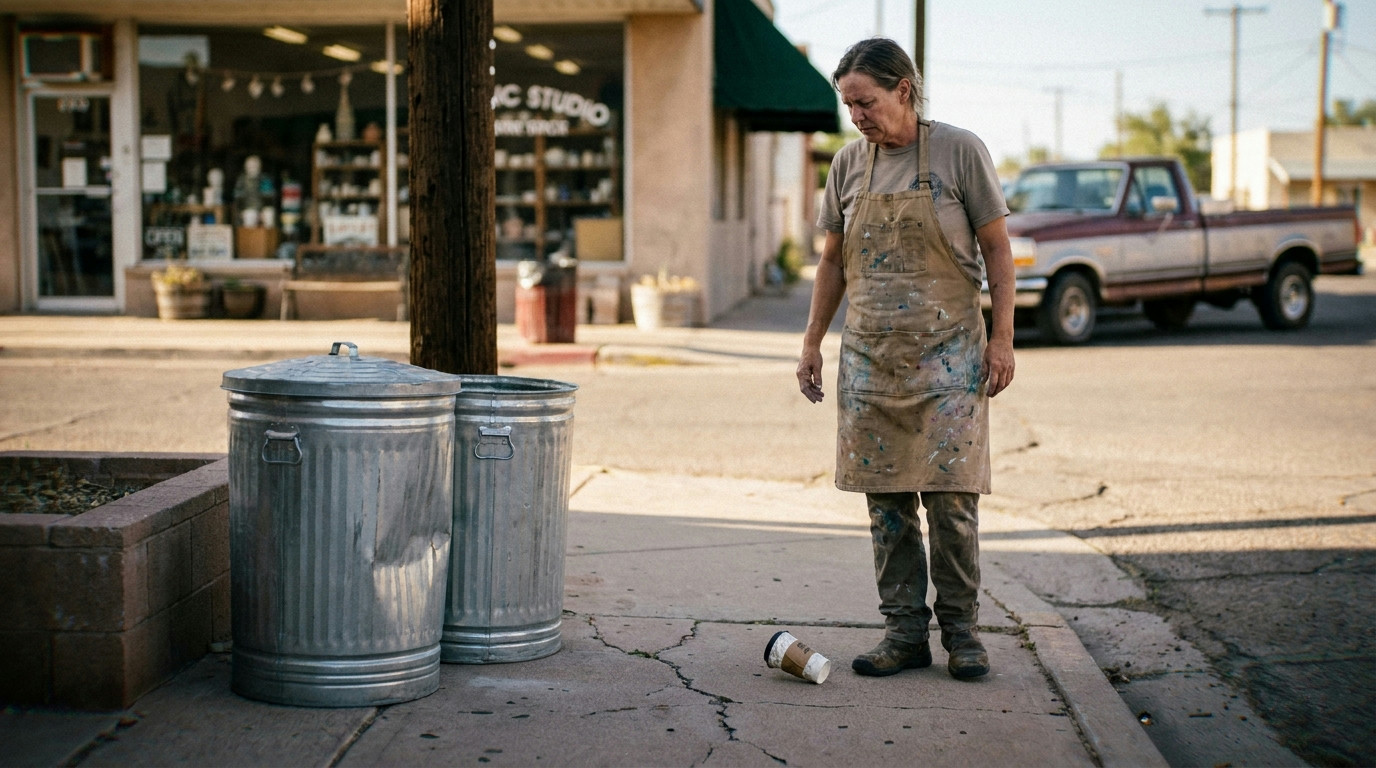
In a small Arizona town, a ceramicist throws away a paper coffee cup. Again and again, it returns, challenging the laws of physics and the sanity of the person it chose.
The stain was the thing she couldn’t explain. A perfect crescent of dried coffee, the color of old rust, just below the rim of the yellow paper cup. The cup was sitting on her otherwise immaculate kitchen counter, right next to the French press she had washed and put away not ten minutes before.
It was the third time she had found it.
Lena G., 34, is a ceramicist. She lives alone in a small adobe house on the steep slope of Tombstone Canyon, just outside of Bisbee, Arizona. Her days are quiet, measured by the slow turning of the wheel and the patient heat of the kiln. She is a woman who works with fundamentals: water, earth, pressure, fire. She understands how a thing comes to be, and how it can be undone. Her hands, when we met in late October, were covered in a fine grey dust that seemed to have settled into her very lines of her skin.
The first cup was unremarkable. She’d bought it on a Monday from a small cafe downtown, a flat white to go. She drank it on the drive home, the late autumn sun sharp and low over the Mule Mountains. She remembered crushing it slightly in her hand as she got out of her car, the waxy paper crinkling under her grip. She tossed it into the recycling bin in her kitchen. The next morning, it was on the counter.
“At first, you think you’re losing your mind,” she said, her voice soft, her gaze fixed on a distant point in the desert sky. “You think, ‘Okay, I’m tired, I’m stressed, I made a mistake.’ The world is solid. You can trust it. But the cup was telling me I couldn’t.”
She assumed she’d bought two by accident, or that she’d taken the first one out of the bin for some reason she couldn’t recall. She threw it away again, this time in the larger can outdoors. She felt a flicker of annoyance, the kind that comes from a small, inexplicable break in routine.
Two days later, she found it sitting on the passenger seat of her Subaru. The slight crumple near the top was identical. The rust-colored crescent of a stain was there. This time, she felt a different sensation. Not fear, not yet. It was a feeling of deep, neurological confusion, like reading a sentence where one word has been replaced by a color.
That afternoon, she took a black Sharpie and drew a small, deliberate star on the bottom of the cup. She drove it five miles out of town, to a public dumpster behind a gas station that smelled of diesel and hot asphalt. She placed it inside, on top of a heap of greasy paper bags, and closed the heavy plastic lid. She drove home feeling a sense of finality, of an absurdity righted.
The next morning, it was on her potter’s wheel. The black star on the bottom was stark and clear. It was sitting dead center on the clay-spattered bat head, a flimsy piece of manufactured disposability occupying the space reserved for creation.
---
The cup did not seem malevolent. It did not move on its own or whisper in the night. Its strangeness was quieter, more fundamental. It violated a law of physics so basic it doesn’t have a name, the one that says a thing, once discarded, is gone. It broke the simple covenant of cause and effect.
“I tried everything,” Lena told me. She wasn’t looking at me, but at her own dusty hands, turning a small lump of clay over and over. “I buried it. I drove it to Douglas and left it in a trash can at a park. Once, I filled it with water and just watched it, to see if it would do anything.”
It never did. It just was.
Eventually, she stopped trying to get rid of it. The effort was producing a friction in her mind that was becoming unbearable. The attempt to force reality to behave as expected was more exhausting than simply accepting that, in this one small way, it would not.
She picked it up from the wheel and washed it carefully in her studio sink, a reverence usually reserved for her own glazed creations. She dried it and placed it on a high shelf, next to a row of bisque-fired mugs that obeyed all the known rules of their existence.
She says she doesn’t think about it much anymore. Her work continues. The kiln fires, the clay centers, the glazes melt and harden as they should. But something in her relationship with the physical world has been permanently altered.
“It’s like finding a typo in a sacred text,” she said quietly. “You can’t unsee it. You know the perfection you thought was there isn’t. And you have to wonder how many other mistakes are hiding in the pages.”
The yellow cup sits on its shelf, inert and patient. A ghost of an object, or perhaps an object that has forgotten how to be gone. It asks nothing and explains nothing. It only remains, a silent testament to the fact that the rules of the world are perhaps more like suggestions, and that sometimes, for reasons we will never understand, a thing decides it is not finished with us.