
Voices Beyond The Veil
The Signal in the Noise
April 24, 2026
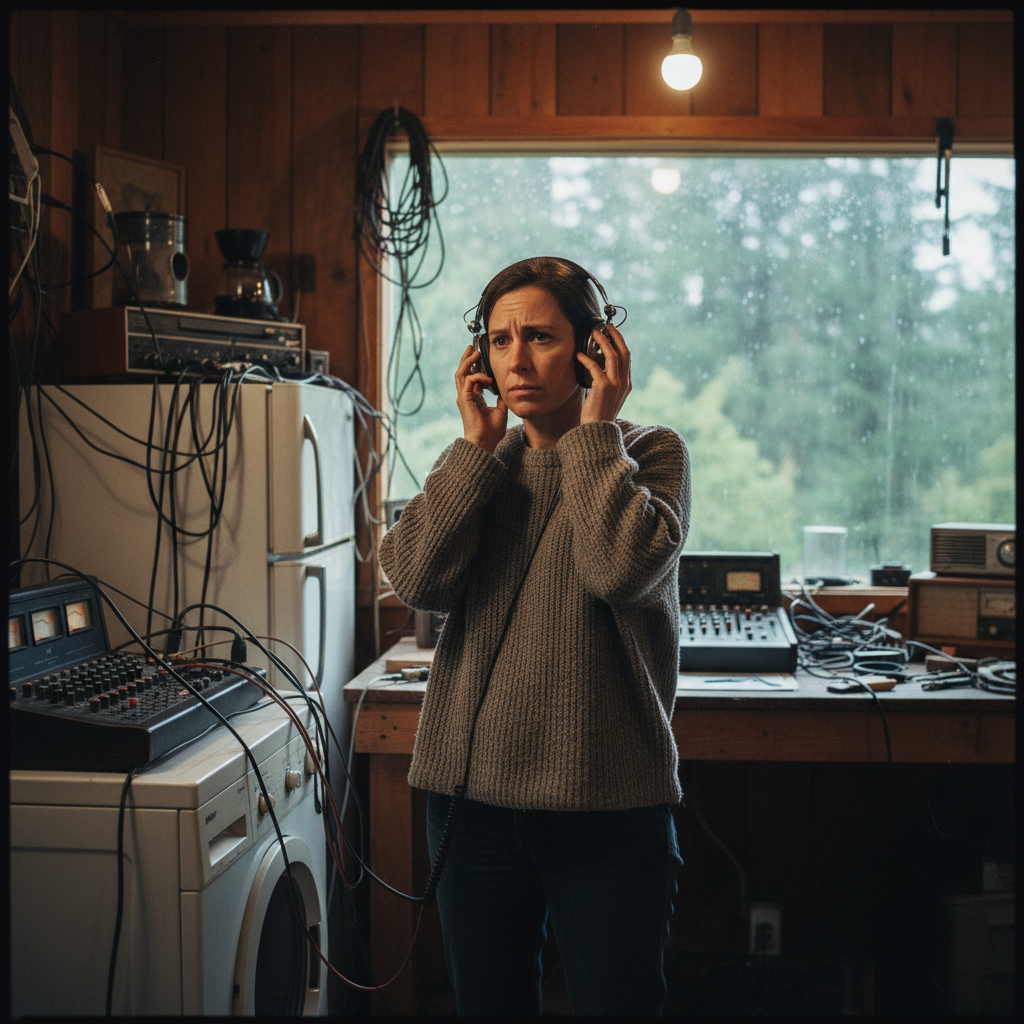
A sound designer in the Pacific Northwest believes a voice is learning to speak to her from the hum of her appliances. But she is the only one who can hear it.
The first thing she played for me was the silence.
Elena R., 38, sat at a vast mixing console in a darkened room that smelled of warm electronics and the damp salt air of Port Townsend, Washington. It was late October, and a persistent drizzle slicked the windows of her converted garage studio. She clicked a mouse, and a low hiss filled the monitors, the sound of nothing, the sound of a room with the gain turned all the way up.
“This is the noise floor from a vocal take last spring,” she said. Her voice was steady, practiced. “Standard stuff. Room tone, preamp hiss, the electrical grid. I was cleaning up the track, you know, gating the pauses between words.”
She moved the mouse again, isolating a fraction of a second of the hiss, looping it. Hiss-hiss-hiss. Then she adjusted an equalizer, carving away frequencies. The sound changed. It became thinner, more focused. A pattern emerged from the static, a faint, rhythmic pulse, like a distorted breath. *Shhh-huh. Shhh-huh.*
It was a deeply unnerving sound, the ghost of a biological process buried in a digital file. A glitch. An artifact. But to Elena, it had become something else entirely.
She has lived in this small Victorian seaport for six years, drawn by the quiet. As a freelance post-production sound editor, her life is an exercise in applied listening. She spends her days surgically removing unwanted sounds: the rumble of a truck from a dramatic scene, the rustle of a lapel mic against an actor’s shirt, the almost-imperceptible hum of a refrigerator on a film set. She is a connoisseur of sounds that are not supposed to be there.
“At first, I thought it was apophenia,” she said, looking past me toward a humming server rack in the corner, its blue lights blinking in the gloom. “Just my brain making patterns. Audio engineers are primed for that. We listen for the ghost in the machine. It’s just... usually the ghost is a 60-cycle hum from bad wiring.”
But the pattern didn’t go away. A few weeks after finding it in the audio file, she heard it again. This time it was in the drone of the bathroom fan. The same rhythm, the same strange, airy texture, though at a different pitch. She recorded the fan with a high-sensitivity condenser microphone and brought the file into her workstation. After hours of filtering, there it was. *Shhh-huh. Shhh-huh.*
It was the beginning of an obsession that has quietly reordered her life.
Her studio, once a model of professional order, now bears the marks of a strange new purpose. A parabolic microphone is aimed at the ancient refrigerator in her kitchen. A hydrophone, typically used for recording underwater, is coiled next to the dishwasher. She has run cables from her main console to microphones pointed at wall outlets, fluorescent lights, even a particular knot in the cedar siding outside that whistles when the wind blows from the north.
She is hunting for a voice.
---
The rhythmic breathing was just the first phase. Over the summer, the sounds grew in complexity. The pattern began to break, to stutter, to form new shapes that felt less like breathing and more like the cadence of muffled speech. She started keeping a log, documenting each new “utterance” with the date, time, source, and a phonetic approximation.
*July 12. Air conditioner compressor. Sounds like ‘s-s-seven.’*
*August 2. Static between AM radio stations. ‘ow-er.’*
*September 5. Computer fan. A clear ‘hello.’*
That was the turning point. The word “hello” was not shouted from the static. It was, she explained, woven into its very fabric. She played the recording for me. It took several tries, but I eventually heard it—or believed I did. A whisper-thin anomaly in the whir of the fan blades, a shape that my brain, prompted by her, interpreted as a word.
“It doesn't have a pitch, not really,” she explained, her focus absolute. “It’s like the *idea* of a voice. All texture and air. It uses the sound that’s already there. It rearranges the noise.”
What truly unnerves her is not that a voice is speaking from the hum of the world, but that it seems to be learning from her. The vocabulary is built from fragments of her own life. After a phone call with her mother about her father’s health, she isolated the word “better” from the fizz of a seltzer bottle. After she spent an afternoon muttering in frustration over a difficult project, a new sound appeared in the drone of the dehumidifier.
“Last week, I was frustrated and I muttered, ‘Just give me a clean take,’” she told me, her eyes fixed on the waveform display. “Yesterday, the dishwasher was running, and I swear I heard it. A whisper, right in the hiss of the water jets. *Clean take.* It sounded... blank.”
She has told no one. Not her family, not her few friends in town. How could she? She is a professional listener, and she is hearing things. There is no simpler path to a diagnosis. Instead, she works, cataloging the phenomenon with the same dispassionate rigor she applies to her job. She is building an archive of a voice that only she can hear, a voice that is learning to speak by listening to her.
Before I left, she led me to a single microphone on a stand in the center of the live room, pointed at nothing. It was aimed at the dead air. She put on a pair of headphones and handed me another, both plugged into a preamp with the gain dialed to its absolute maximum.
“Listen,” she whispered, her eyes closing.
I put the headphones on. There was only the roar of amplification, a tidal wave of hiss. I listened for a breath, a word, a pattern. I listened for the shape of a voice in the chaos, for a signal in the noise.
I heard nothing but the sound of an empty room, pushed to its breaking point. But Elena was smiling, a faint, private, hopeful smile. She was leaning forward, as if to catch a secret meant only for her. And in the silence of my drive away from her house, the hum of my own car’s engine seemed, for the first time, full of possibility.